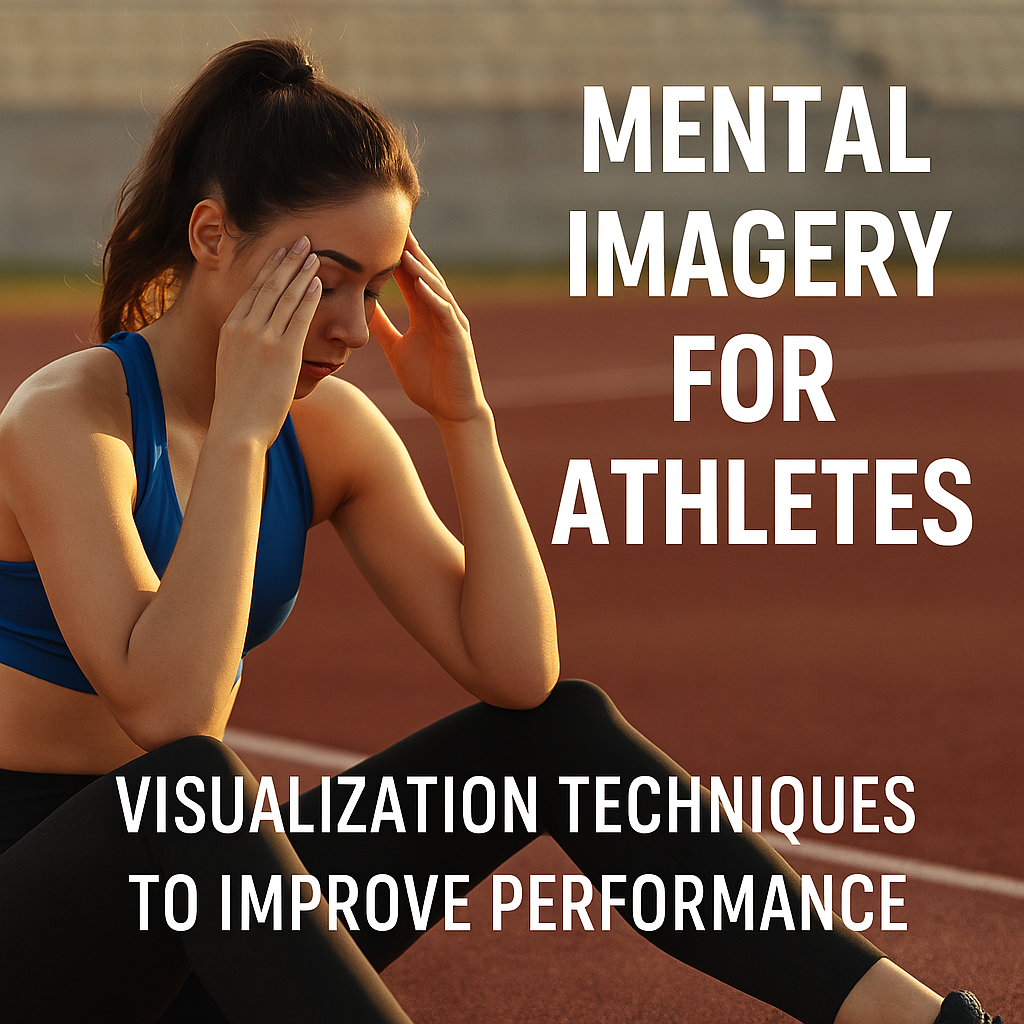
When Serena Williams walked onto the court at Wimbledon in 2012, she admitted her hands were trembling. Not because of the opponent across the net but because of the picture in her mind, a classic example of mental imagery for athletes, often called visualization training. That same year, Alex Rodriguez (Mind Gym) described how he saw himself holding the MVP trophy long before he ever won it
Stories like these highlight a powerful truth backed by sport psychology research: mental imagery for athletes, also known as visualization training, is one of the most effective ways to sharpen focus, build confidence, and perform under pressure
What Is Mental Imagery in Sports?
Mental imagery, sometimes called visualization or motor imagery, is more than “daydreaming.” It is the deliberate, multi-sensory rehearsal of a skill or performance situation seeing, hearing, and even feeling the action without physically moving
Psychologists like Robin Vealey and Sam Forlenza (in Applied Sport Psychology) describe imagery as a mental training tool for athletes. It activates the same neural pathways as actual practice. This enhances motor learning, confidence, and focus. Neuroscientists back this up with the psychoneuromuscular theory: when you vividly imagine serving a tennis ball, your motor cortex lights up almost as if you performed the serve

The most widely applied framework today is the PETTLEP model, which ensures imagery is realistic and effective:
- P – Physical: Imagine while holding the racket, wearing gear.
- E – Environment: Rehearse in the actual court/field, or picture it vividly.
- T – Task: Focus on the same movements you will perform.
- T – Timing: Imagine in real-time speed, not fast-forward.
- L – Learning: Adapt imagery as your skills evolve.
- E – Emotion: Rehearse with the same emotions (nerves, excitement).
- P – Perspective: See it both through your own eyes and as an observer
In simple terms: the more life-like your imagery, the stronger its impact. Athletes who practice imagery correctly don’t just “see success”—they train success into their nervous system.
Why Mental Imagery Works (Science + Flow)
When an athlete visualizes a skill, the brain doesn’t fully distinguish between imagined and actual movement. This is why neuroscientists describe imagery as a “mental rehearsal” that primes the body for action.
Two major psychological theories explain why Metal Imagery works:
1. Psychoneuromuscular Theory
- First proposed by Carpenter (1894), refined in modern sport psychology.
- Imagining a movement triggers subtle muscle activity, strengthening neural pathways.
- Example: a tennis player mentally rehearsing serves activates the motor cortex, building “muscle memory” without lifting the racket
2. Bio-Informational Theory
- Proposed by Lang (1979).
- Imagery activates associative memory networks in the brain, making the body respond as if the scenario is real (heart racing, palms sweating)
- This means athletes who rehearse both skill + emotional response (nerves, pressure, excitement) perform better under real conditions
3. Flow Connection (Csikszentmihalyi)
- In Flow in Sports, Jackson & Csikszentmihalyi explain that optimal performance happens when challenge and skill are balanced.
- Imagery bridges this gap: athletes picture themselves succeeding in “just-right” challenges, building confidence to enter the flow state.
- Example: a runner imagines overtaking an opponent in the final stretch, aligning effort with belief—making the flow experience more likely.
Key takeaway: Imagery works because it combines neural rehearsal, emotional conditioning, and flow psychology. Done consistently, it prepares both the body and mind to treat competition as familiar territory, not hostile ground.
Stories from Elite Athletes
Stories from Elite Athletes: How Champions Visualize
Science makes the case, but stories prove it. The world’s greatest athletes have long treated mental imagery as invisible practice—often crediting it as their edge when talent and training alone weren’t enough
Michael Jordan, Kobe Bryant, and the NBA’s Secret Weapon
In The Mindful Athlete, George Mumford describes how Phil Jackson brought him to the Chicago Bulls. Later, he joined the Lakers to teach mindfulness and imagery. Michael Jordan learned to rehearse every play in his mind before executing it, while Kobe Bryant practiced “being in the moment” blending imagery with calm breathing to face high-pressure free throws
Shaquille O’Neal described Mumford’s techniques as a way to “reset” mentally during games, using mental rehearsal to keep focus after mistakes. These stories highlight a truth: mental imagery is not just for preparation, it’s a tool for recovery in the middle of battle
Alex Rodriguez: Seeing the Trophy Before Winning It
In Mind Gym, Gary Mack shares how Alex Rodriguez, before his MVP season, visualized himself holding the award, hitting .380, and lifting trophies. He rehearsed not just the technical swing but the feeling of triumph. That year, he narrowly missed MVP by three votes but did win the batting title. His reflection: “Playing the game was the easy part. The real work was in the preparation.”
Rodriguez’s story is a masterclass in pairing imagery with belief—a reminder that athletes win twice: once in the mind, once in the arena
The Inner Game of Tennis: Quieting the Inner Critic
Timothy Gallwey’s The Inner Game of Tennis introduced the concept of Self 1 (the critical voice) and Self 2 (the body’s natural ability)
Gallwey taught players to use mental imagery to quiet Self 1 instead of overthinking mechanics, athletes pictured the ideal serve or rally, allowing the body to execute fluidly
This approach spread far beyond tennis, shaping modern coaching across sports: trust your trained imagery, not your anxious thoughts.
Flow on the Track: Entering “The Zone”
Susan Jackson and Mihaly Csikszentmihalyi’s Flow in Sports illustrates how runners, swimmers, and climbers use imagery to slip into flow states
By imagining the rhythm of movement, the crowd noise fading, and the body in perfect sync, athletes pre-condition their mind for that immersive “zone” where time slows and performance peaks
Athletes often say, “I’ve run this race in my head a hundred times before stepping on the track.” That’s imagery training in its purest form.
Key Lesson from the Legends:
- Jordan, Kobe, Shaq → imagery for focus + resilience.
- A-Rod → imagery for success + motivation.
- Gallwey → imagery for confidence + self-trust.
- Flow athletes → imagery for peak experience.
Infographic-Style Table: Elite Athletes & Mental Imagery
| Athlete / Source | Imagery Use | Outcome / Impact |
|---|---|---|
| Michael Jordan (The Mindful Athlete) | Rehearsed plays in his mind before executing; used imagery to anticipate in-game decisions. | Improved focus, execution under pressure; led Bulls to 6 NBA titles. |
| Kobe Bryant (The Mindful Athlete) | Blended breathing + imagery before free throws and key moments. | Calm presence in high-stakes situations; increased clutch performance. |
| Shaquille O’Neal (The Mindful Athlete) | Used imagery to mentally reset after mistakes. | Maintained confidence mid-game; reduced performance slumps. |
| Alex Rodriguez (Mind Gym) | Visualized winning MVP and batting title; rehearsed “seeing himself succeed.” | Won batting title; credited visualization for mental preparation. |
| Tennis Players (Gallwey, Inner Game) | Imagery used to silence “Self 1” (critical inner voice) and trust body’s natural ability. | Improved confidence and flow; smoother execution of shots. |
| Track & Swim Athletes (Flow in Sports) | Imagined rhythm, crowd noise fading, body in sync with movement. | Entered “flow state” more easily; peak performance in competition. |
Research Evidence: What Science Says about Mental Imagery techniques for Athletes

Scientific Research based Evidence on Mental Imagery Techniques to Boost Athletic Performance
Research Evidence: What Science Says
If elite athletes provide inspiring stories, research gives us the hard numbers. Over the past three decades, mental imagery has been studied in hundreds of experiments, and the verdict is consistent: imagery boosts performance across sports, from precision skills to endurance
Meta-Analysis 2025: The Numbers Behind Imagery
A systematic review and multilevel meta-analysis published in Behavioral Sciences (2025) synthesized 86 studies, 3,593 athletes. The findings were clear:
- Performance Gains: Imagery enhanced agility, strength, tennis, and soccer performance.
- Best Dosage: ~10 minutes, 3 times per week, over ~100 days produced the strongest improvements.
- Stacking Works Better: Athletes improved more when imagery was combined with self-talk and goal setting compared to imagery alone.
- Who Benefits Most: Both elite and developing athletes saw gains, but the effects were especially strong for skills requiring focus, anticipation, and precision
Takeaway: Imagery isn’t a “mental trick”, it’s a trainable skill with dosage, frequency, and proven ROI
Why It Works: Theoretical Foundations
Sport psychologists explain imagery’s power through two leading theories:
- Psychoneuromuscular Theory: Imagining movement creates small muscle activations, strengthening motor pathways — like “shadow training” for the brain.
- Bio-Informational Theory: Imagery taps associative memory networks. Rehearsing not just skills but emotions (nerves, crowd noise, confidence) ensures athletes respond more effectively under pressure.
Together, these theories explain why visualization feels real — because, to the brain, it partially is real.
The PETTLEP Model: Making Imagery Realistic
One of the most applied frameworks, detailed in Applied Sport Psychology, is the PETTLEP model. Effective imagery should mirror reality across seven dimensions:
- Physical: Use sport-specific gear or posture.
- Environment: Imagine in real competition settings.
- Task: Match imagery to the actual skill.
- Timing: Rehearse in real-time, not sped up.
- Learning: Update imagery as skills evolve.
- Emotion: Integrate real emotional intensity (nerves, joy).
- Perspective: Alternate between first-person and observer view.
Studies show that imagery aligned with PETTLEP principles is far more effective than vague or general visualization routines.
Bridging Science with Practice
The combined weight of meta-analyses, theory, and applied frameworks shows one thing: imagery works best when done deliberately, consistently, and with emotional engagement
It’s not about “closing your eyes and daydreaming.” It’s about training the brain under conditions as close to reality as possible, so when the real moment comes, it feels familiar, not foreign
How to Train Mental Imagery (Step-by-Step Toolkit)
How to Train Mental Imagery: A 4-Week Toolkit for Athletes
Books and research agree on one point: mental imagery works only when practiced regularly, vividly, and with emotion. Just like lifting weights, your “mental muscle” needs structured training. Below is a 4-week routine built from proven methods across sport psychology classics, designed to be practical for athletes at any level
1st week: Building the Foundation
Goal: Learn how to relax, focus, and create clear mental pictures.
- Breathing Reset (The Mindful Athlete)
- Sit comfortably, inhale for 4 counts, hold for 2, exhale for 6.
- Repeat for 2–3 minutes to quiet the mind.
- Tip: Kobe Bryant used this to prepare before big moments.
- Simple Skill Imagery (Applied Sport Psychology)
- Close your eyes, picture a basic movement you know well (dribbling a ball, tying shoes).
- Add senses: What do you see? Hear? Feel in your muscles?
- Practice for 5 minutes daily.
- Self-Talk Cue (Inner Game of Tennis)
- Choose one short phrase (e.g., “smooth swing,” “stay loose”).
- Whisper it while imagining the skill.
- Helps silence “Self 1,” the inner critic.
2nd week: Making Imagery Realistic (PETTLEP)
Goal: Add detail so the brain feels it’s really happening.
- Gear & Environment (PETTLEP – Applied Sport Psychology)
- Wear your actual sports shoes, hold the racket, or sit in your training environment.
- The more realistic, the better.
- Timing Drill (Mind Gym)
- Imagine your action at the exact speed you’d perform it.
- Example: Baseball hitters visualize the pitcher’s throw in real time.
- Emotional Layer (Flow in Sports)
- Don’t just see success- feel the nerves, pressure, and excitement.
- Athletes enter flow when imagery rehearses both skill + emotion.
3rd week: Pressure Simulation
Goal: Train your mind to handle competition stress.
- Game-Day Script (Mind Gym + Applied Sport Psychology)
- Write a short script: entering the arena, hearing the crowd, first move of the game.
- Imagine every detail, from lacing shoes to the whistle.
- Rehearse for 10 minutes, 3 times per week.
- Mistake Recovery Drill (The Mindful Athlete)
- Visualize making a mistake (missed shot, dropped ball).
- Immediately picture yourself resetting with calm breath and refocus.
- This builds resilience — Shaq used it to stay confident mid-game.
- Flow Rehearsal (Flow in Sports)
- Imagine being fully absorbed: movements smooth, time slowing, effortless focus.
- Recall a past “good day” and recreate that rhythm.
4th week: Integration & Performance Ritual
Goal: Blend imagery into a personal performance routine.
- Pre-Competition Routine (Applied Sport Psychology)
- 2 min deep breathing
- 5 min vivid imagery of first plays/moves
- Cue word mantra (e.g., “one point at a time”)
- Quick physical warm-up
- This sequence becomes your “mental warm-up.”
- Future Self Visualization (Mind Gym)
- Picture yourself achieving your goal (winning, lifting trophy, personal best).
- Feel the pride, crowd, teammates.
- Alex Rodriguez rehearsed this nightly before his MVP-level season.
- Daily Reflection (The Mindful Athlete)
- After practice, spend 2–3 minutes replaying the best moment of the day in your head.
- This “mental highlight reel” reinforces confidence.
Key Principles to Remember
- Consistency beats intensity: 10 minutes, 3–4 times a week is better than random long sessions.
- Use all senses: See, hear, feel, and even smell (locker room, field, racket grip).
- Update imagery as you improve: Don’t keep imagining old mistakes-visualize your new best level.
- Link imagery with action: Always pair it with physical practice for best results.
Bottom Line
Mental imagery is not fantasy- it’s neural training, emotional conditioning, and performance rehearsal all in one. Done right, it prepares you to walk into competition feeling like you’ve already been there.
Common Mistakes & Fixes
Common Mistakes Athletes Make in Mental Imagery (and How to Fix Them)
Even though mental imagery sounds simple, many athletes do it ineffectively. Research and coaching experiences (from Applied Sport Psychology, Mind Gym, The Mindful Athlete, and Flow in Sports) show that imagery works only if it’s structured, vivid, and consistent. Here are the most common mistakes and easy fixes:
Mistake 1: Keeping Imagery Too Vague
- Athletes often say, “I see myself winning.”
- But vague images (just seeing a trophy or generic success) don’t train the brain to handle specific actions or situations.
✅ Fix:
- Use detailed scripts (crowd noise, grip of the racket, sound of the ball).
- Follow the PETTLEP model: include physical, environment, task, timing, learning, emotion, and perspective.
- Example: Instead of “I score,” imagine dribbling past two defenders, feeling your breath, hearing the referee’s whistle, and then scoring.
Mistake 2: Imagining Only Perfection
- Many athletes only picture the ideal outcome.
- Reality: mistakes and setbacks happen — and if the mind never rehearsed recovery, athletes panic when errors occur.
✅ Fix:
- Practice “reset imagery” (from The Mindful Athlete).
- Example: Imagine missing a shot, then immediately breathe, refocus, and successfully take the next one.
- This builds resilience and reduces in-game frustration.
Mistake 3: Ignoring Emotions
- Some athletes visualize only the technical move (swing, sprint) without the stress, nerves, or pressure of competition.
- Result: imagery feels safe in practice but fails under real pressure.
✅ Fix:
- Add emotional realism. Picture the butterflies in your stomach, the sweaty palms, the noise of the crowd — and then rehearse staying calm and focused.
- Flow in Sports shows this helps trigger the “zone” where skill and challenge balance out
Mistake 4: Practicing Randomly
- Doing imagery “when I feel like it” has little effect.
- Just like the gym, progress comes from consistency, not occasional effort.
✅ Fix:
- Schedule sessions: ~10 minutes, 3 times a week, over ~100 days (the dosage supported by meta-analysis).
- Treat it like physical training-log your practice in a journal
Mistake 5: Wrong Perspective (Only First-Person or Only Observer)
- Some athletes only imagine from “inside their eyes” (first-person) OR only as if watching themselves (third-person).
- Both perspectives activate different mental processes.
✅ Fix:
- Combine both: start from first-person (feel the swing, hear the sound), then switch to third-person (see yourself from the stands).
- Applied Sport Psychology notes this creates richer imagery and better transfer to performance
Mistake 6: Not Linking to Physical Practice
- If imagery is done separately without connecting to real drills, it stays “mental” and doesn’t transfer fully to the field.
✅ Fix:
- Always pair imagery with physical practice.
- Mind Gym suggests using imagery right before or after physical reps. e.g., do a free-throw, close eyes and replay it mentally, then take another shot
Bottom Line
Mental imagery fails when it’s too vague, too perfect, or too random. It succeeds when it’s vivid, realistic, emotional, and consistent. Champions don’t just see the highlight reel, they train their minds to handle pressure, recover from mistakes, and repeat success until it feels automatic
Conclusion & A Call to Action
Conclusion: Champions Win Twice — First in the Mind, Then on the Field
When Serena Williams admitted her hands trembled before Wimbledon, or when Alex Rodriguez visualized his MVP season in advance, they weren’t using magic, they were using mental imagery
The science is clear: imagery strengthens neural pathways, conditions emotional resilience, and primes athletes for the flow state where performance feels effortless. The stories are inspiring: Jordan, Kobe, Shaq, and countless others have trusted imagery as much as physical training. And the toolkit is practical: a few minutes, three times a week, rehearsing success and recovery with vivid detail.
The truth is simple: mental imagery is not an extra, it’s training for your brain, just as important as training your body
Leave a Reply